


Fullerenes: A Remarkable Discovery of Modern Science
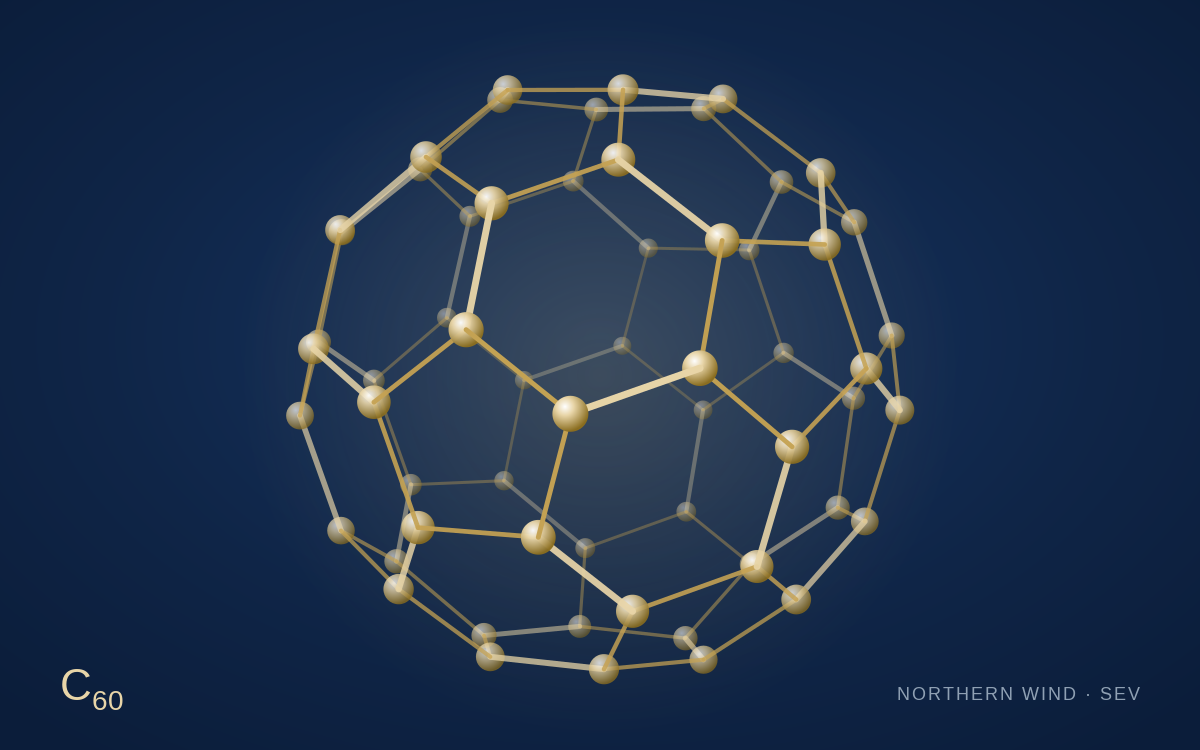
The molecule that changed our idea of carbon
Can you imagine a football made of just sixty atoms? That is exactly the remarkable molecular structure scientists discovered in 1985.
The discovery became one of the most important events in the history of modern chemistry.
Until then, the best-known forms of carbon were diamond and graphite. It turned out, however, that carbon atoms can form entirely unusual closed molecular structures.
One of them was fullerene C₆₀ — a molecule whose surface is made up of twelve pentagons and twenty hexagons.
It was named after the American architect Richard Buckminster Fuller, famous for his geodesic domes.
In 1996, Harold Kroto, Robert Curl and Richard Smalley were awarded the Nobel Prize in Chemistry for the discovery of fullerenes.
What are fullerenes?
Fullerenes are a family of carbon molecules whose atoms form closed, hollow structures.
The best-known members of this family are C₆₀ and C₇₀.
Their unusual physical and chemical properties have attracted the attention of researchers all over the world.
Today fullerenes are studied in fields such as nanotechnology, electronics, energy, materials science, pharmacology, biology and medicine.
Their interaction with living organisms is of particular interest.
Fullerenes and free radicals
Complex chemical processes take place in the human body all the time, and they are accompanied by the formation of free radicals.
Free radicals take part in natural physiological processes, but an excess of them can contribute to damage to cell structures.
An imbalance between the formation of reactive oxygen species and the body’s protective mechanisms is called oxidative stress.
Under laboratory conditions, some forms of fullerenes are able to neutralise free radicals.
Under certain conditions, however — in particular when exposed to light — fullerenes can instead promote the formation of reactive oxygen species.
This dual nature makes them an especially interesting subject of scientific research.
Fullerenes and the medicine of the future
Could an unusual carbon molecule become a tool of modern medicine?
Today researchers are looking at several promising directions.
- Targeted drug delivery. Fullerene derivatives are being studied as potential carriers of medicinal substances.
- Oncology. The use of modified fullerenes is being investigated in photodynamic therapy, in which exposure to light makes it possible to damage tumour cells.
- Neurobiology. The possibility of protecting nerve cells from certain types of damage is being studied.
- Oxidative stress. The antioxidant properties of certain fullerene-based compounds are being investigated.
These directions are mostly at the experimental and preclinical stages.
There is not yet sufficient clinical evidence that ordinary fullerene can selectively destroy damaged cells in the human body or treat diseases.
Fullerenes and longevity
One of the most attractive areas of research is the possible effect of fullerenes on the processes of ageing.
Individual experiments on animals have given rise to a hypothesis about a potential effect of C₆₀ on lifespan.
However, the results of animal experiments cannot automatically be transferred to humans.
Independent clinical studies, long-term observation and careful safety assessment are needed.
At present there are no sufficient scientific grounds to regard taking fullerenes as a proven way of slowing ageing or extending human life.
Why does the purity of fullerene matter?
The biological properties of fullerene-based substances may depend on a whole range of factors:
- The degree of chemical purity.
- The production method.
- The presence of impurities.
- The solvent used.
- Chemical modification of the molecules.
- Storage conditions and exposure to light.
At the same time, a high degree of purity does not in itself guarantee safety.
In 2024 the scientific journal EXCLI Journal published the results of a short-term oral toxicity study of dissolved fullerene C₆₀ in rats.
The results of this study are of scientific interest, but they do not prove that long-term use of fullerenes by humans is safe. When assessing the work, the commercial interest of some of its authors should also be taken into account.
In 2023 the European Commission’s Scientific Committee on Consumer Safety pointed out that the available data were insufficient to assess the safety of fullerenes and a number of their derivatives in cosmetic products.
Questions of safety therefore remain open.
Between a scientific discovery and a new medicine
History knows many cases in which unusual scientific discoveries became the basis of revolutionary technologies.
Yet the path from a laboratory experiment to a safe and effective medicine can take decades.
Fullerenes deserve attention not because miraculous properties are attributed to them, but because they are a truly remarkable achievement of modern science.
Perhaps further research will make it possible to create fundamentally new medical technologies based on them.
What exactly those technologies will be, the future will show.
A culture of health is a culture of knowledge
In opening the new section “Culture of Life”, the international Northern Wind project sets itself the task of introducing readers to the achievements of modern science, interesting discoveries and promising technologies.
We will follow the development of fullerene research, report on new scientific publications and share the views of specialists with our readers.
Our principle is respect for scientific knowledge, objectivity and a clear line between proven facts and hypotheses.
The story of fullerenes continues.
And perhaps its most interesting pages have yet to be written.
The editorial team of Northern Wind, an international cultural, educational and publishing project.
Culture of Life — the art of living.
Scientific sources
- The Nobel Prize in Chemistry 1996 (R. F. Curl Jr., Sir H. W. Kroto, R. E. Smalley). NobelPrize.org
- Kroto H. W., Heath J. R., O’Brien S. C., Curl R. F., Smalley R. E. C60: Buckminsterfullerene. Nature. 1985;318:162–163. doi:10.1038/318162a0
- Bakry R., Vallant R. M., Najam-ul-Haq M., Rainer M., Szabo Z., Huck C. W., Bonn G. K. Medicinal applications of fullerenes. International Journal of Nanomedicine. 2007;2(4):639–649. PMCID: PMC2676811
- Baati T. et al. The prolongation of the lifespan of rats by repeated oral administration of [60]fullerene. Biomaterials. 2012;33(19):4936–4946. doi:10.1016/j.biomaterials.2012.03.036
- Grohn K. J. et al. C60 in olive oil causes light-dependent toxicity and does not extend lifespan in mice. GeroScience. 2021;43(2):579–591. doi:10.1007/s11357-020-00292-z
- European Commission, Scientific Committee on Consumer Safety (SCCS). Opinion on Fullerenes, hydroxylated Fullerenes and hydrated forms of hydroxylated Fullerenes (nano). SCCS/1649/23, final opinion, 26 October 2023
- Burres C., Wong R., Pedreira F., Da Silva Pimenta M., Moussa F. A regulatory compliant short-term oral toxicity study of soluble [60]fullerenes in rats. EXCLI Journal. 2024;23:772–786. doi:10.17179/excli2024-7084 (funded by SES Research Inc.; two authors co-own the company, which sells C60 products)
The materials in this section are for educational purposes only and are not medical advice. For health questions, please consult a doctor.